
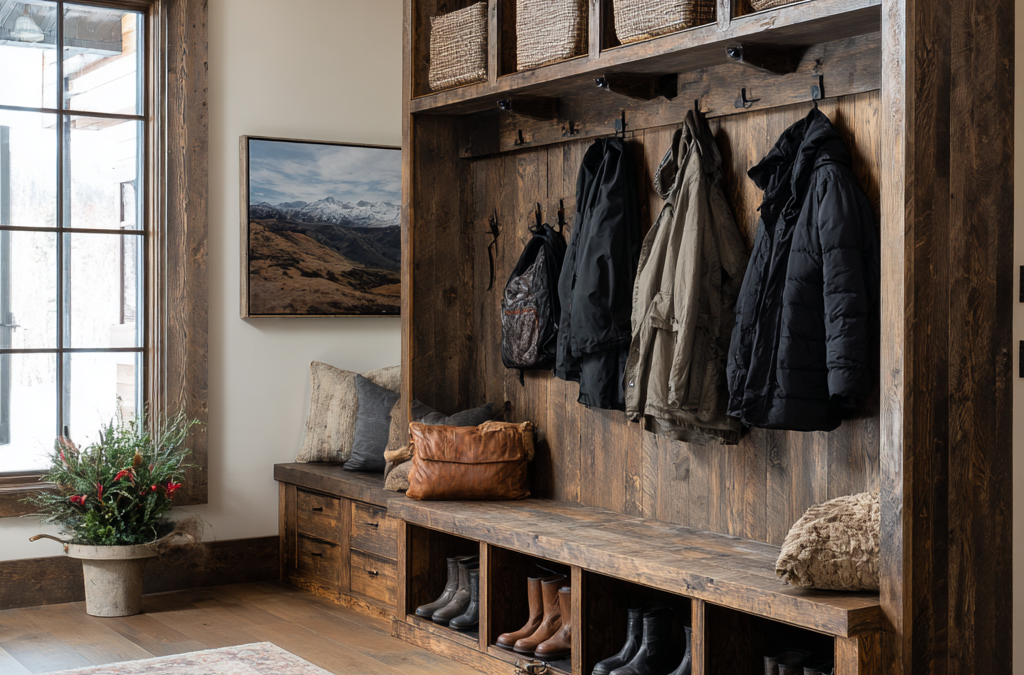
Winter in Montana has a way of showing you what your entryway is really made of.
One minute it’s a clean hallway. The next it’s a pile of boots, wet gloves, dog leashes, ski helmets, and enough gravel to resurface a driveway. If your home is in Bozeman, Big Sky, or anywhere in the Gallatin Valley, you don’t need a prettier entry. You need one that can take a hit and keep the rest of the house from paying for it.
That’s where mudroom and entry built-ins come in. Done right, they don’t just look nice. They control the chaos, protect your floors and walls, and make winter living easier every single day.
Below are practical, real-world mudroom built-in ideas for Montana and entryway storage custom cabinets we build for homeowners who are tired of fighting the winter mess.
The Montana winter mess problem (and why built-ins win)
A good mudroom isn’t about having a magazine-ready bench. It’s about creating a system that handles:
- Wet boots and snow gear
- Heavy coats and damp gloves
- Backpacks, groceries, and dog stuff
- Kids coming in at full speed
- Adults coming in with tools, ski gear, or work boots
A freestanding rack can help, but it rarely lasts. Built-ins are sturdier, easier to clean around, and designed for your exact traffic flow.
If you want to see what custom cabinetry looks like when it’s built for real life, start here
8 built-in storage ideas that hold up in Montana winters
1) Lockers with a place for the wet stuff
Lockers are the backbone of a hardworking mudroom, especially in a Big Sky home mudroom where winter gear tends to multiply.
What makes lockers actually useful:
- A hook zone at kid height and adult height
- An upper cubby for helmets, hats, and gloves
- A lower zone that can handle boots without getting destroyed
If you want it to stay clean, add doors to the upper section and leave the lower boot zone open. You get the best of both worlds: tidy at eye level, practical at floor level.
2) A bench you can actually sit on (and built to stay put)
Benches are great in theory until they’re too shallow, too tall, or too flimsy.
A good mudroom bench:
- Gives you a stable place to pull on boots
- Includes deep drawers or lift-up storage underneath
- Uses materials and joinery that don’t wobble after one season
Deep drawers under a bench are one of the most underrated upgrades. They’re perfect for scarves, extra mittens, dog towels, and the gear you don’t want on display.
3) Boot storage that won’t ruin your floors
Boots are the number one offender. They drip, they stink, and they grind grit into everything.
Practical boot solutions include:
- Built-in boot trays with raised edges
- Slatted shelves that allow airflow
- A dedicated lower cubby per person
The key is keeping water contained and giving boots a chance to dry. A little airflow goes a long way in January.
4) Tall utility cabinets for brooms, vacuums, and winter supplies
Mudrooms attract “stuff” because they’re convenient. Without a plan, that stuff ends up on the floor.
A tall cabinet can hold:
- Brooms, mops, stick vacuums
- Ice melt, boot sprays, snow brush
- Cleaning supplies and paper products
This is where custom sizing matters. We build these to fit your actual tools, not an imaginary set that came with the house.
5) Counter space for the drop zone
Not every mudroom needs a counter, but when you have the wall space, it’s a quality-of-life upgrade.
A small counter gives you:
- A place to set groceries and packages
- A landing spot for keys and mail
- A surface for sorting gear and school stuff
Add a couple of upper cabinets or shelves and it becomes the command center that keeps your kitchen counter from becoming the default drop zone.
6) A charging drawer or power nook (quietly life-changing)
If your household runs on phones, headlamps, and earbuds, a charging zone prevents the kitchen from becoming the electronics graveyard.
Common options:
- A charging drawer with built-in outlets
- A hidden shelf with power for devices
- A small cabinet nook with cord management
This is one of those features you don’t brag about, but you’ll appreciate it every day.
7) Paneling and trim that can take a beating
This is where the wall protection comes in. Paint alone doesn’t love boot scuffs and wet gear.
Great wall finishes for mudrooms:
- Shiplap or tongue-and-groove paneling
- Wainscoting with a durable top rail
- Strong baseboards and corner protection
A mudroom is a high-impact zone, which means your trim and paneling should be chosen like you choose work boots: tough and built for the job.
8) Hooks and hang zones with the right spacing
Hooks are simple. Hook layouts are not.
What we design for:
- Enough spacing so coats don’t overlap and stay damp
- Hooks at kid level so kids can actually use them
- A dedicated “wet gear” zone near the floor or a vented area
When hooks are planned right, you stop having piles. When they’re planned wrong, you still have piles—just with hooks above them.
Durable finishes and materials for a mudroom that lasts
Mudrooms get abused. That’s not a design failure; it’s their job.
For Montana winters, we typically recommend:
- Durable, shop-applied finishes (especially for painted built-ins)
- Satin sheens for easy cleaning and good wear resistance
- Thoughtful edge protection in toe-kick and floor zones
- Hardware that can handle heavy daily use
If your existing mudroom built-ins need refinishing, touch-ups, planing, or repairs, our shop can help keep them in good shape
Layout tips that keep the entry from becoming a traffic jam
A mudroom system doesn’t just store gear. It manages flow.
A few practical rules:
- Keep the boot zone closest to the door
- Put hooks above the boot zone so wet gear stays contained
- Allow enough clearance for doors and drawers to open without blocking the path
- If space is tight, go vertical with taller cabinetry and open cubbies
Even a small entryway can work well if every element is doing a job and nothing is fighting the path of travel.
When a built-in upgrade beats a full remodel
Not every home needs a full mudroom overhaul. Many winter mess problems can be solved with a targeted upgrade:
- Add lockers and a bench where a blank wall exists
- Replace a flimsy rack with built-in cubbies
- Add a tall utility cabinet to get things off the floor
- Add paneling to protect the wall in the highest-impact zone
A “micro-remodel” mudroom project often gives the highest daily return for the least disruption.
Ready to build an entry that works in winter?
If your entryway becomes a mess every January, that’s not a personal failure. It’s a storage system problem. The fix is designing built-ins that match your household and your winter reality.
If you want help planning a mudroom or entry upgrade, we’ll talk through layout, finishes, and storage priorities and help you build a system that earns its keep.
FAQ
What are the best mudroom built-in ideas for Montana winters?
Lockers, a solid bench with storage, dedicated boot trays or cubbies, and durable wall protection like shiplap or wainscoting are the most effective upgrades for winter gear and moisture.
How do I make a small entryway work like a mudroom?
Go vertical. Use tall cabinetry, a narrow bench with drawers, and a compact hook-and-cubby system. The goal is to contain gear without blocking the walkway.
What finishes hold up best in a mudroom?
Durable shop-applied finishes in satin sheen tend to perform best. They’re easier to clean and more forgiving in high-traffic, high-contact zones.